Posts

Rules-Based Data Transformation with Intelligent Document Processing

  Rules-Based Data Transformation with Intelligent Document Processing by  Sujith Parakkunnath , on September 6, 2022 9:00:00 AM PDT Document rules (also known as business rules) are the icing on the cake for an Intelligent Document Processing (IDP) solution. You can enjoy a delicious cake even without the icing but a baker can transform a simple cake into a multi-layered piece of art with the addition of this sweet, adaptable medium. It is his playground to be creative and make the cake unique. Similarly, an IDP solution can offer you good extraction results but if you want to customize or transform the extracted data to your process needs, you need document rules. What is data transformation? Data transformation is the process of transforming raw data into a clean, consumable format. When processing documents, required data is extracted by an IDP solution, pre-processing logic needs to be applied to ensure the output data is in a standard format and ready to be consumed by y...

IDP: A Booster Shot for your RPA, Chatbot and Low Code Implementations

Image
  Although businesses across various industries have benefited from automation technologies such as robotic process automation (RPA), low-code platforms and chatbots, most are yet to explore the opportunity to automate their end-to-end business processes with powerful AI- and machine learning (ML)-powered tools. RPA, chatbots and low-code platforms are a great start to help cut manual costs, reduce process times and improve customer experience but as business processes get increasingly complex, these technologies fall short of reaping higher efficiencies. They can help you get small wins quickly but when you try increasing the level of automation you can achieve, you hit a wall because of their limitations. The reason these technologies can fall short when handling complex processes is because most businesses need these types of tools to handle unstructured data of some sort. A few examples include: •  A customer uploads an expense receipt to its chatbot but it does not know h...

How To Evaluate An IDP Partner?

Image
  Choosing a new technology partner is like making a move in a chess match. A wrong move from your end gives your opponent a competitive edge. While automation is inevitable in today’s world, picking the wrong partner for automating business processes can be a detrimental move for your business. In our recent conversations, we have seen many companies choose Infrrd once they have become frustrated with their vendors after the first year of partnership. This is not about bragging but rather a true statement based on feedback from these new clients. We tried to understand why this happened and assumed it was due to a lack of effort invested in the evaluation of very critical aspects of the platform. This resulted in choosing an IDP partner that could deliver short-term benefits without the vision of how their solution would perform in the long term. How can companies make an informed decision when choosing an Intelligent Document Processing (IDP) partner and avoid wasted efforts whil...

Infrrd Cited in Two Recent Gartner Hype Cycle Reports

Image
  400 U.S.-based Companies Processing More than One Million Invoices Annually Cite Dramatic Increase in IDP Adoption for Accounts Payable FunctionCompany Recognized as Sample Vendor for Intelligent Document Processing SAN JOSE, Calif. … August 23, 2022 …  Infrrd , a leading provider of Intelligent Document Processing (IDP) solutions, announced today it was named a Sample Vendor for IDP in two recent  Gartner  Hype Cycle reports. Both reports cite the role of IDP in business process improvement. The first report,  Hype Cycle for Natural Language Technologies, 2022 , published on July 11, 2022, discusses how advances in artificial intelligence and (AI) and machine learning (ML) are driving innovation and fostering advances in natural language technologies (NLT)and designates where these new opportunities and methods can prove most beneficial. The report states that, “ IDP uses natural language technologies and computer vision to extract data from structured and un...

A Great Start vs. a Great Finish

Image
  What happens when you read a book that starts well but does not end well? Or, vice versa? The beginning of a book sets the tone, mood, expectation, etc., and if the ending does not meet these, you will likely be disappointed. In the same way, a great ending may leave you satisfied but perhaps you were forcing yourself to hang on until the end if the beginning was not interesting enough. Certainly, the best book or movie experiences can be witnessed when all of it is great. It should have both a great start and a great finish. Similarly, when it comes to automation, the optimum solution is the one that offers both a great start and a great finish. Several IDP solutions offer a great start where AI-based API solutions extract data with 70% or 80% or even 90% out-of-the-box accuracy. But the struggle may start once the manual data entry team is required to invest a lot of time to achieve 100% accuracy. On the other hand, there are Business Process Outsourcing (BPO) solutions that ma...

Using Alerts To Gain Efficiency For Document Processing

Image
  How do alerts make repetitive processes efficient? Let’s for a moment consider the job of a supervisor level in a manufacturing plant. And, this person’s responsibility is to monitor the temperature gauge in the boiler and ensure that the temperature does not rise above 300 degrees. There are two ways to do this job: one is to keep looking at the gauge and make necessary adjustments when necessary; and, the second is to set up a gauge that can imitate the operator when the temperature crosses 200 or 250 degrees. Which option is more effective? It has to be Option 2, Right? Relevant alerts/notification helps to smartly execute tasks. There is no way to effectively manage remote jobs without email or slack notifications, otherwise, we would miss all the important tasks that need immediate attention. There are many shopping portals that alert us when our desired item is on sale so that we don’t miss out on purchasing them. We are alerted every year to file our taxes on time to avoid...

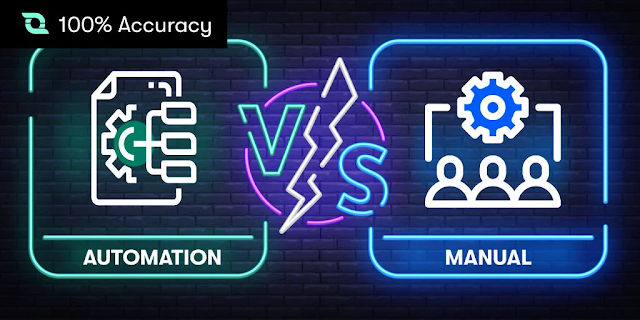
100% Accuracy and the (Hard) Choice Between Automation and Manual Document Processing

Image
  During an interaction with an industry leader about his experience with IDP, said he had recently decided to automate his document extraction process because of the challenges faced with data inaccuracy and cost. He said their IDP platform currently provided 90 to 95% accuracy. He added that a manual team handled the remaining 5% to 10% of corrections. What he said next inspired this blog post. He said  95% accuracy does not look like 95% accuracy  and his manual team had to put a lot of effort into corrections. This is a familiar case with many businesses that have chosen automation with high expectations. What exactly is the problem in this scenario? Let me try to shed some light. One of the popular perspectives or oversights many of us have is that 95% accuracy means 95% correct values.  This is not true. 95% accuracy does not translate to 95% correct values.  It means that there is a 95% probability that a value is correct, or in other words, there is a 5%...

Learning from similarity and information extraction from structured documents

Image
It is a human tendency to formulate assumptions while analyzing the difficulty of information extraction in documents. We automatically assume it is easier to extract information in the form of named entities from a set of similar documents. Nonetheless, similar-looking documents have a distinct set of problems. The named entities in these document types vary in size, akin to the number of characters, words, height, width, and location. These variations cannot be handled using heuristics or pre-trained language models. When we have exhausted all the modeling options, we look for a new direction. The method s presented here is an exploration of deep learning techniques to improve the information extraction results [4]. To evaluate the techniques, a dataset with more than 25,000 documents has been compiled, anonymized, and published. It is already known that convolutions, graph convolutions, and self-attention can work together and exploit all the information present in a structured docu...

Launching Infrrd IDP's Latest Features

Image
We entered 2022 with focused goals, an industry-driven product roadmap, and a futuristic perspective. As we kick off this third quarter, we remain focused on providing you features to help our users reap the best results from our Intelligent Document Processing (IDP) platform. Here are some of the major features and enhancements from our latest release. Business Rules for Document Processing Infrrd's IDP solution now provides options in the user interface to perform derivations or calculations on extracted data to transform them based on your individual requirements. Users can achieve this by configuring business rules. Previously, contacting Infrrd’s customization team was required and now, some of these capabilities are available from the IDP user interface. This will result in significant time savings as available business rules can simply be configured and managed within the Infrrd IDP platform rather than routing it through the Infrrd customization team. Read more about this f...

Infrrd’s 100% Document Accuracy. Delivered (eBook)

Inside this eBook is a detailed guide to understanding Infrrd’s 100% document accuracy offering. With less than 100% accuracy, you will still need manual review and corrections. Even if an IDP solution offers as high as  95% accuracy, this still only results in a 50% efficiency gain from the process. 100% document accuracy offering completely eliminates the need for manual work resulting in 100% efficiency gain. It allows your business to divert precious human resources for higher cognitive tasks while bringing down processing times and processing cost per document. This eBook covers topics including: •  Understanding what difference accuracy makes to your processes •  What is 100% document accuracy? •  How does Infrrd deliver this? •  How 100% accuracy transforms document processing Download eBook

Ask Infrrd #2: Why Are There So Few Successful Mortgage OCR Solutions?

Image
  Welcome to the second post in the Ask Infrrd series - your platform to have an honest, candid conversation about everything related to document data extraction. In this series we answer frequently-asked questions for our IDP experts or that we receive at  hello@infrrd.ai . Here, we answer another question about Mortgage processing. Q: Why are many mortgage companies unable to find an effective OCR partner who can show results? A:  Before we delve into the answer, let us take a step back and learn more about why OCR solutions have struggled to deliver effectiveness for most industries, not just Mortgage. OCR technology was designed to solve a different problem than data extracting. OCR was a means to convert images with text to digitized text that can be read on a computer. If we are only considering this function of OCR, then I would argue that it has done a phenomenal job and come a long way since it was originally created. OCR engines of today can read very low-qualit...

The Case for 100% Accuracy

Image
  The Great Resignation and Data Entry Jobs There is no doubt that COVID-19 changed the world dramatically during the past two years. It has also set the “Great Resignation” into motion. According to  Pew Research , the “quit rate” in the U.S. reached a 20-year high in November 2021. With this vacuum for talent, many companies have started changing their criteria for entry-level technical positions. This resulted in quite a few data entry candidates quickly moving into entry-level IT roles. Hiring and training a manual data entry team efficiently is no longer easy in today’s ever-changing work environment. Most companies struggle to hire, manage, and upscale their data entry teams while facing a churn rate of 50%-60%. To reduce their dependence on manual labor, most businesses seek out an automation solution. The first hurdle is figuring out the mix of and determining the balance between automation and human effort. For example, if a business spends $50,000 per month processin...